Focus on testing, not framework engineering
The Spring Boot of Selenium
One dependency. Sensible defaults. Playwright-inspired APIs. Reports, retries, and CI gates built in —without hiding Selenium.
Listed on selenium.dev/ecosystempublic class LoginTest extends BaseTest {
@Test
public void login() {
open("/login");
getByLabel("Username").fill("admin");
getByRole(Role.BUTTON)
.withName("Sign in").click();
assertThat(getByText("Welcome"))
.isVisible();
}
}Every Java team rebuilds the same BaseTest,DriverFactory, and wait utilities.Stop maintaining plumbing.
New · Project generator
Start a project in one minute
Pick Maven or Gradle, TestNG or JUnit 5, and download a working Selenium Boot project. Unzip it, run one command, and watch a real test pass. It's built in your browser — nothing is uploaded.
Build tool
Runner
$ unzip my-project.zip && cd my-project
$ mvn test
Tests run: 1, Failures: 0 — BUILD SUCCESS
Needs Java 17+ and the browser you pick.
What you get
Outcomes first — the API is right there
Playwright's best ideas, brought into the Selenium ecosystem. Sensible defaults do the rest.
Never write Thread.sleep() again
WaitEngine
Every action auto-waits on a centralised engine with 10+ built-in conditions, so fixed sleeps and most timing flakes go away.
Tests survive CSS & DOM refactors
Accessibility-first locators
getByRole, getByLabel, getByText, getByTestId — target the accessibility tree, not brittle selectors.
Assertions that don't flake on timing
Web-first assertThat()
assertThat(locator).isVisible() auto-retries until true or the timeout — no manual polling.
Known-flaky tests stop blocking your build
@Retryable + RetryListener
Global, per-method, or per-scenario retries absorb transient failures. Quarantine known-flaky tests without deleting them.
Hand stakeholders a report they'll read
HTML report + JUnit XML
Tabbed dashboard — overview, cases, failures, flakiness radar. JUnit XML parsed natively by any CI.
Safe parallel execution by default
ThreadLocal DriverManager
One driver per thread, isolated and thread-safe. Scale across methods or classes with a config flag.
CI that configures itself
CiEnvironmentDetector
Auto-detects GitHub Actions / Jenkins / GitLab. Headless forced, threads tuned, pass-rate gates enforced.
Extend it without forking it
SPI plugin toolkit
Registry-based plugins for custom drivers, hooks, and report adapters. The escape hatch most never need.
Before / after
Delete the boilerplate, keep the intent
No driver setup. No Thread.sleep(). No brittle CSS selectors. Just the test.
public class LoginTest extends BaseTest {

    @Test
    public void login() {
        open("/login");                    // baseUrl from config
        getByLabel("Username").fill("admin");
        getByLabel("Password").fill("secret");
        getByRole(Role.BUTTON)
            .withName("Sign in").click();  // auto-waits

        assertThat(getByText("Welcome"))
            .isVisible();                  // web-first, retries
    }
}
// Raw Selenium — you own all of this
WebDriver driver = new ChromeDriver();
driver.manage().timeouts()
.implicitlyWait(Duration.ofSeconds(10));
driver.get("https://example.com/login");
Thread.sleep(2000); // hope the page is ready
driver.findElement(
By.cssSelector("#login-form .btn-primary")).click();
// screenshots, retries, reporting, teardown…
// all your problem
driver.quit();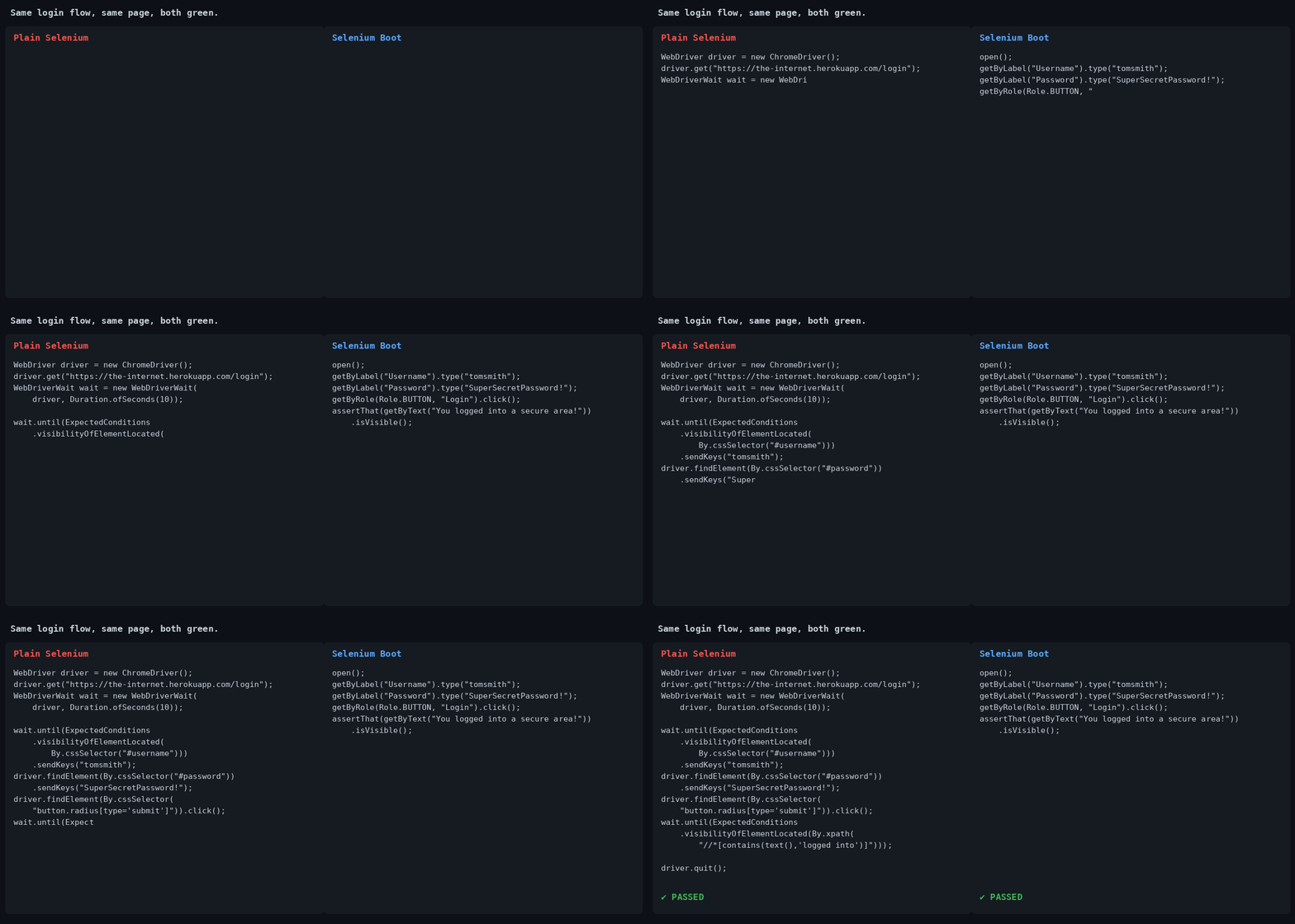
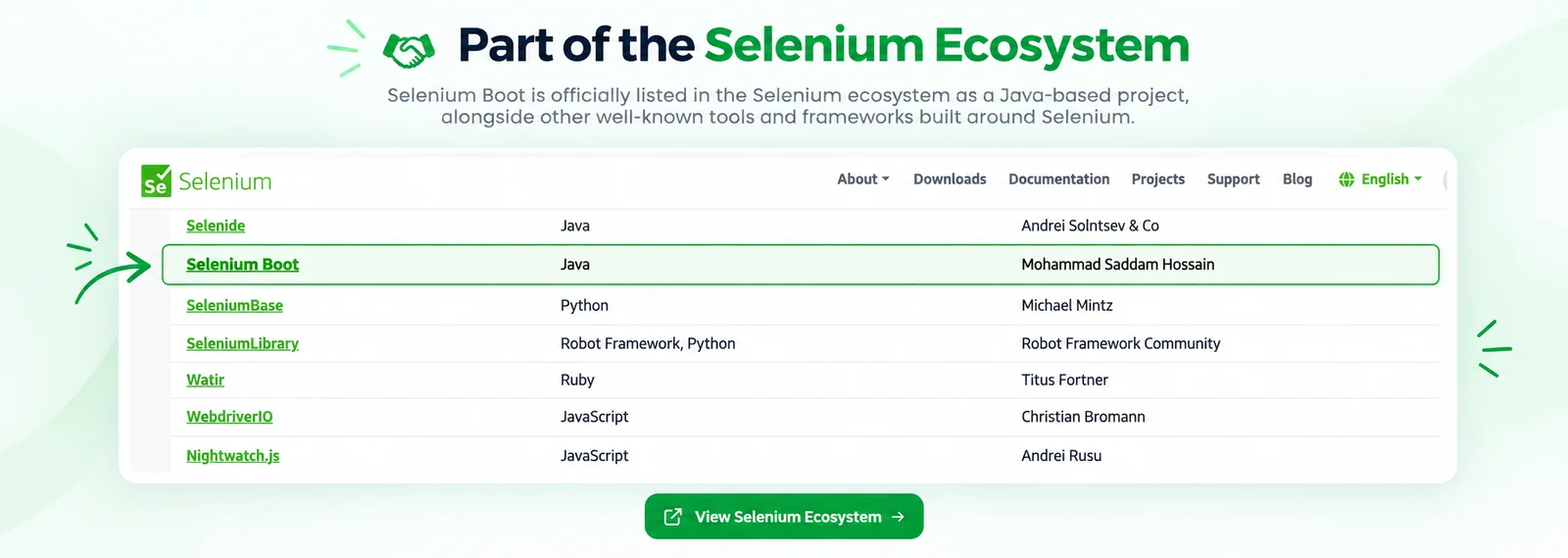
Selenium Boot builds on WebDriver rather than replacing it. It is an independent project — a listing on selenium.dev is not an endorsement by the Selenium project.
One ecosystem
One framework, with tooling around it
Start with the framework. The MCP server, migrator, and IDE plugins are optional extras that build on it.
MCP Server
pip installAI-powered test authoring
Let Claude or Copilot drive a real browser, record a session, and generate framework-native, accessibility-first tests.
PyPI · seleniumboot-mcpMigrator
CLIMove an existing Selenium project over
Scan a Selenium Java project, see what maps onto Selenium Boot and what needs a human, and write a migrated copy. Early release.
Learn moreIntelliJ Plugin
IDEA 2024.2+JetBrains Marketplace
Spring-Initializr-style New Project wizard, selenium-boot.yml schema completion, and a one-click run config.
JetBrains MarketplaceVS Code Extension
MCP-readyVisual Studio Marketplace
Project scaffolding and MCP integration so codegen stays framework-aware right inside your editor.
VS Code MarketplaceTwo credible reasons
Why Selenium Boot?
Whether you're maintaining a home-grown framework or already invested in Selenium.
Why not just build your own?
| Roll your own | Selenium Boot |
|---|---|
| Write & maintain driver lifecycle, waits, retries | Provided, thread-safe, zero config |
| Build a reporting layer from scratch | HTML report + JUnit XML included |
| Bespoke CI wiring per project | Auto-detects GitHub Actions / Jenkins / GitLab |
| Onboarding = "read our internal wiki" | Onboarding = public docs + one dependency |
| You fix the bugs | The framework ships the fixes |
Already invested in Selenium?
| Playwright idea | In Selenium Boot |
|---|---|
| Accessibility-first locators | getByRole / getByLabel / getByText — survive CSS refactors |
| Auto-waiting | WaitEngine-backed actions — no Thread.sleep() in test code |
| Web-first assertions | assertThat(...) that auto-retries until true |
| Convention over configuration | Sensible defaults, optional selenium-boot.yml |
FAQ
Common questions
Is Selenium Boot a replacement for Selenium?
No. It is built on WebDriver and never hides it: the raw driver and every Selenium API stay available. Selenium Boot takes over the plumbing around it — driver lifecycle, waits, retries, configuration and reporting.
How does it compare to Playwright?
They are different tools. Playwright is its own automation stack. Selenium Boot is for teams that are staying on Selenium and want ideas like accessibility-first locators, auto-waiting and web-first assertions inside it. It does not try to replace Playwright.
Can I use it with my existing Selenium tests?
Yes. You can add it to an existing project and adopt it test by test. The Migrator (early release) analyzes a project read-only, reports what maps cleanly and what needs a human, and can write a migrated copy without touching your original.
What do I need to run it?
Java 17+, Maven or Gradle, and Chrome or Firefox. Selenium Manager fetches the driver binaries. TestNG and JUnit 5 are both supported.
Do I need the MCP server or the IDE plugins?
No. The framework works on its own. The MCP server, Migrator and IDE plugins are optional extras that build on it.
Is it free?
Yes. It is open source under Apache-2.0. It is an independent project; a listing on selenium.dev is not an endorsement by the Selenium project.
Keep your test code. Delete the plumbing.
Add one dependency and focus on testing — not framework engineering.
<dependency>
  <groupId>io.github.seleniumboot</groupId>
  <artifactId>selenium-boot</artifactId>
  <version>3.8.0</version>
</dependency>Or start from a working project:use the starter template ↗